Horror story ideas with a twist: a premise generator, a scoring test and 12 ideas
Good horror ideas are built, not waited for. A three-slot premise formula, six kinds of twist, a fairness test, a small generator and a way to score ideas before you write one.
By Homingo Learn ·
Lists of horror story ideas are easy to find and hard to use. Most are a setting with a mood (“an abandoned hospital”), which is not yet a story. A short horror piece, written or animated, needs a premise you can say in one breath, a rule the audience understands at once, and a twist that makes them replay what they just saw. This guide gives you a way to build those, plus twelve original ideas to start from.
A premise in three slots
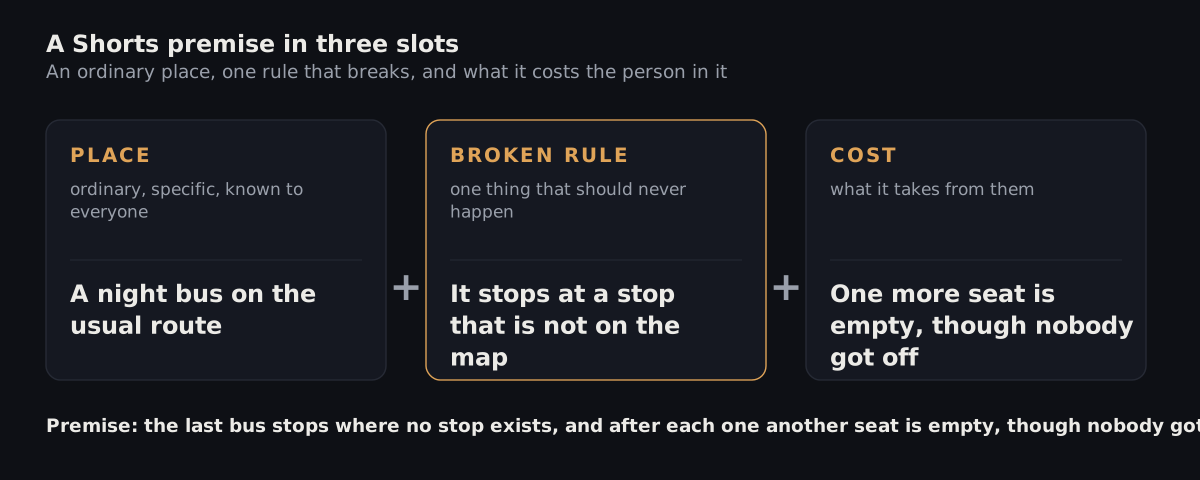
- Place: ordinary and specific. Everyone has been on a night bus, in a lift, in a university exam hall. Familiar places make the wrong detail stand out, and you skip the explaining.
- Broken rule: one thing that should never happen, stated in a single line. One. Two strange things at once read as random; one strange thing reads as a pattern.
- Cost: what the broken rule takes away, and it should grow. A cost that escalates writes the middle of the story for you.
Test the premise by saying it aloud in one sentence. “A commuter on the last bus notices it stops where no stop exists, and after each stop one more seat is empty, though nobody got off.” If you need a second sentence to explain the rule, the rule is too complex for a short piece.
Six kinds of twist
A twist is not a surprise. A surprise adds new information at the end; a twist re-reads information the audience already has. These six cover most twists that work in short horror:
- Identity: the narrator is not who we thought. They are the cost, the cause, or already gone.
- Time: it already happened, it is about to happen, or it keeps happening. The clue was a date, a timestamp or a sound repeating.
- Inversion: the safe thing is the threat. The rule the hero followed to survive is what made it worse.
- Scale: it is not one, it is everyone. The last shot widens to show the pattern everywhere.
- Purpose: the thing was not hunting. It was warning, counting or waiting, and now the earlier scenes mean something else.
- Point of view: we were watching from the wrong side. The camera, the caller, or the voice was the presence all along.
The fair-twist test
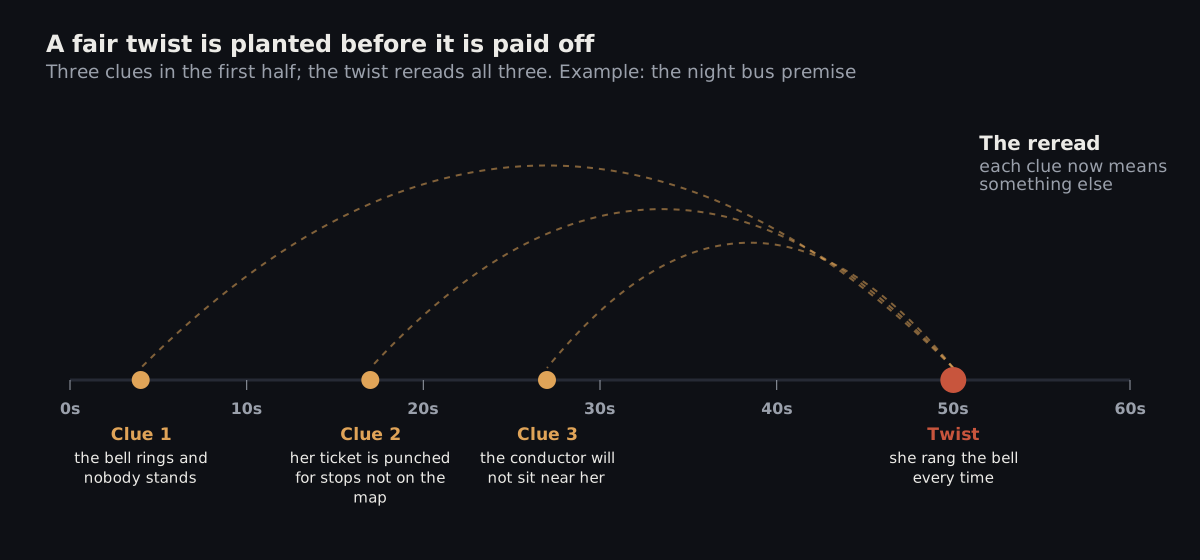
A twist feels earned when the audience could have guessed it and did not. Check four things:
- Planted early: at least two clues sit in the first half. In a 60-second Short, the first clue belongs in the opening seconds.
- Visible, not told: each clue is something seen or heard (a punched ticket, a bell nobody else rang), not something a narrator explains.
- Rereads the clues: after the twist, each clue means something new. If a clue means the same thing before and after, cut it or change it.
- One image: the twist lands as a single picture or a single line. If it needs a paragraph, it is a lore dump, not a twist.
A premise generator in Python
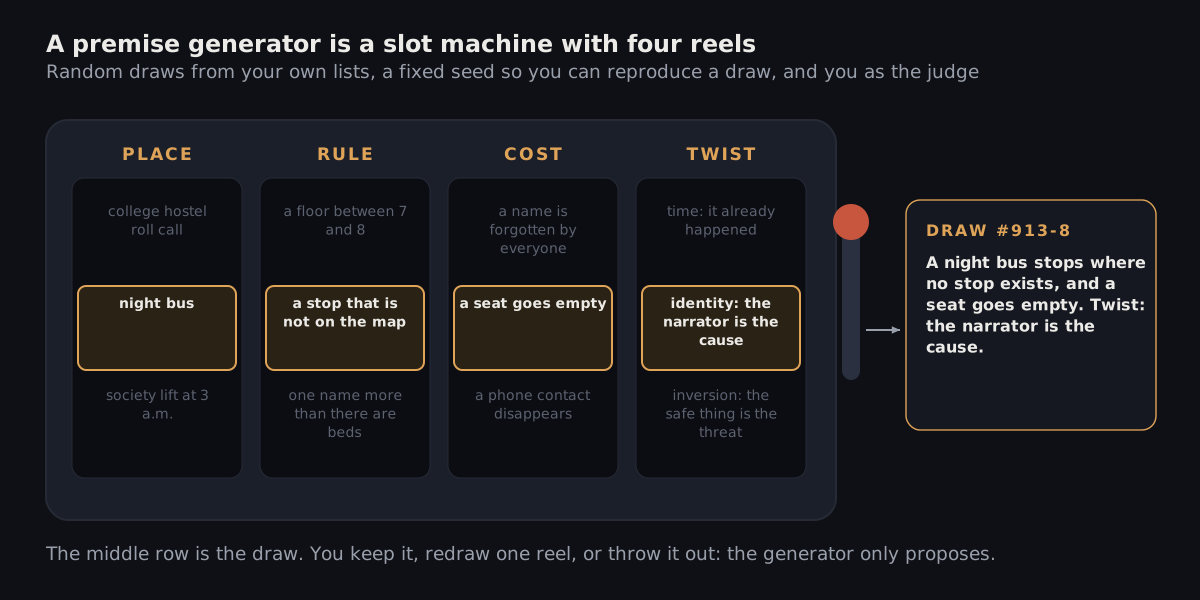
Write your own lists, one per slot, and let a script combine them. The combinations are not stories, they are prompts for your judgement: most draws are nonsense, and every so often a pairing gives you something you would not have thought of. Keep the lists yours, specific and drawn from places your audience knows.
import random
import sys

PLACES = ["night bus", "society lift at 3 a.m.", "college hostel roll call",
          "railway waiting room", "university exam hall", "night-shift CCTV room", "rented flat, first week"]
RULES = ["a stop that is not on the map", "a floor between 7 and 8", "one name more than there are beds",
         "a train you missed years ago, on time today", "one paper more than students",
         "footage of a round you have not walked yet", "a doorbell that rings only when you are out"]
COSTS = ["a seat goes empty", "someone comes back slightly wrong", "a name is forgotten by everyone",
         "a phone contact disappears", "a memory goes missing", "the count goes up by one"]
TWISTS = ["identity: the narrator is the cause", "time: it already happened", "inversion: the safe thing is the threat",
          "scale: it is happening everywhere", "purpose: it was a warning", "point of view: the camera is the presence"]


def draw(rng: random.Random) -> dict:
    return {"place": rng.choice(PLACES), "rule": rng.choice(RULES),
            "cost": rng.choice(COSTS), "twist": rng.choice(TWISTS)}


if __name__ == "__main__":
    seed = int(sys.argv[1]) if len(sys.argv) > 1 else 913
    rng = random.Random(seed)
    for n in range(10):
        d = draw(rng)
        print(f"#{seed}-{n}: {d['place']} | {d['rule']} | {d['cost']} | twist {d['twist']}")
premises.py: random premise drafts from your own lists. Same seed, same draws. Standard library only.
Run it, read the ten lines, and circle the two that make you want to know more (with the default seed 913, draw #913-8 is the night bus draw in the figure). Then rewrite each as a one-sentence premise in your own words. Do not keep a draw as it is: the script only shuffles words, the premise is your work.
Prompts that expand and score ideas
An AI model is useful for the two boring parts: expanding a draw into variations, and scoring a long list against your criteria. It is weak at taste, so keep the choosing for yourself. A prompt that works:
You are helping me develop short horror story premises (60-second vertical videos, adult audience,
scary through mood and dread, no gore).

Premise: [one sentence]

1. Write 8 variations. Each keeps the place but changes the broken rule or the cost.
   Each variation: one sentence premise, the twist in one line, and its twist type
   (identity, time, inversion, scale, purpose, point of view).
2. For each variation, list 3 clues that could be shown on screen in the first 30 seconds.
3. Score each from 1 to 5 on: frame-0 image (is the first image strange on its own?),
   rule in one line, fair twist (planted and rereads the clues), series legs (could it run 3+ parts?).
4. Reject any variation that relies on a cliche: a mirror scare, a doll, "it was all a dream",
   a jump scare with nothing behind it.
Return a table sorted by total score. Do not write any story yet.
Prompt for Claude or another model: expand one premise into variations and score them. Paste your premise in place of the bracket.
Score ideas before you write any of them
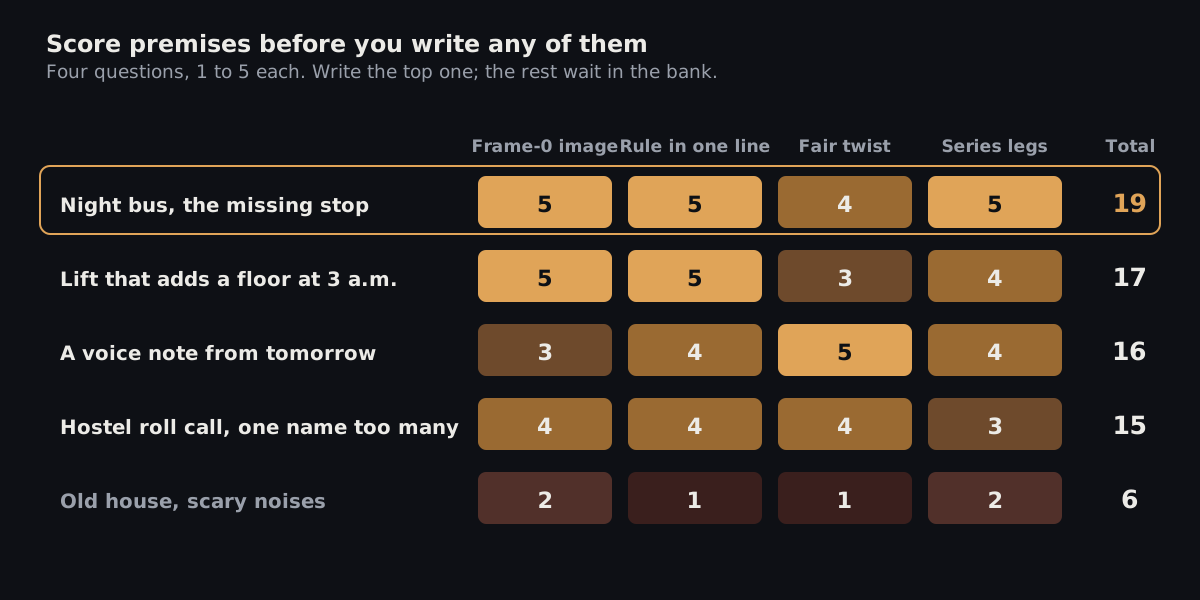
Writing is the expensive part, so spend it on the best idea. Score every premise on four questions, 1 to 5 each, and only write the top one. The rest go into an idea bank; a premise that scores 15 today may score 18 after a better twist arrives next week. Notice how “old house, scary noises” scores: it has no rule, no cost and nothing to twist. It is a setting, not a premise.
Our animated horror reels skill starts one step later: its hook-first story method takes a premise like these to a beat sheet and an episode spec.
12 horror story ideas with a twist
Original premises built with the method above, each with its twist type. Use them as they are, or swap one slot and make them yours.
- The missing stop. The last bus stops where no stop exists, and after each one another seat is empty, though nobody got off. Twist (identity): she rang the bell every time.
- Floor 7½. At 3 a.m. the society lift shows a floor between 7 and 8. Residents who press it return a minute later, unable to say their flat number. Twist (time): the lift log shows the narrator pressed it last week.
- Roll call. The college hostel warden reads one name more than there are beds, and everyone answers. Twist (scale): every floor’s list is one name longer tonight.
- Voice note, 2:14 a.m. A voice note arrives from your own number, timed tomorrow: “Do not open the door.” Twist (identity): at 2:13 the knock comes, and it is your voice asking to be let in.
- The train you missed. The waiting-room board lists a train you missed years ago, on time today. Twist (purpose): the board is not offering you the train; it is telling you the passenger who missed it with you never left the waiting room.
- The round not walked. A night guard sees CCTV footage of himself walking a corridor ten minutes before he does. Twist (inversion): tonight the footage shows the corridor empty at the time he should pass, so he stays in the control room. The control room is where it waits.
- One paper too many. In a university exam hall, the invigilator counts one answer sheet more than students. Twist (time): it is in your handwriting, already marked, dated next year.
- The doorbell log. A new flat’s doorbell rings only when nobody is home, and the camera always misses the visitor. Twist (identity): the first ring is timestamped the day you came to see the flat.
- Inverter beeps. In a power cut, inverters across the colony beep one house at a time, getting closer. Twist (purpose): the beeps are counting the homes where someone is still awake.
- Group photo. In every office photo since you joined, a colleague stands one step further from the group. Twist (scale): in today’s photo, everyone stands one step further from you.
- Delivery pin. The rider is marked “arrived”, no one is at the door, and the map pin moves slowly through your flat. Twist (identity): the order was placed from your phone, while you were asleep.
- Highway fog. Every dhaba on the foggy highway has the same waiter, who already knows your order. Twist (point of view): the bill he brings is for a party of two. You came alone, and he keeps looking at the chair beside you.
Every idea here is scary through a broken rule and a growing cost, not through injury. Dread built that way needs no gore, and it keeps your work clear of graphic-content limits.
Planning a run of episodes from one premise? Faceless YouTube Shorts with AI shows how a series bible keeps them consistent.
Horror story ideas in Hindi
The same formula works in Hindi, and spoken Hindi suits horror narration: short, direct sentences carry dread better than literary Hindi. Write the premise the way you would tell it to a friend at night:
- “Raat ki aakhri bus ek aise stop par rukti hai jo kisi map par nahi hai. Har stop ke baad ek aur seat khaali ho jaati hai, jabki koi utra hi nahi.”
- “Raat teen baje lift saatvin aur aathvin manzil ke beech ek floor dikhati hai. Jo wahan jaata hai, woh ek minute mein laut aata hai, par apna flat number bhool jaata hai.”
- “College hostel ki roll call mein warden ek naam zyada padhta hai. Aur har koi ‘present’ bolta hai.”
- “Raat 2:14 par apne hi number se ek voice note aata hai: ‘Darwaza mat kholna.’ 2:13 par dastak hoti hai, aur awaaz aapki apni hai.”
- “Bijli jaate hi colony ke inverter ek-ek ghar karke beep karte hain, aapke ghar ki taraf badhte hue. Woh un gharon ko gin rahe hain jahan koi abhi jaag raha hai.”
- “Dhaabe ka waiter do logon ka bill laata hai. Aap akele aaye the, aur woh baar baar aapke bagal wali khaali kursi ko dekhta hai.”
The same idea in Devanagari, for captions or a written story: “रात की आखिरी बस एक ऐसे स्टॉप पर रुकती है जो किसी नक्शे पर नहीं है। हर स्टॉप के बाद एक और सीट खाली हो जाती है, जबकि कोई उतरा ही नहीं।”
For Hindi captions in a video, keep one script per video (Devanagari or Hinglish) and about seven words per caption. Our Hindi guide AI se horror video kaise banaye covers captions and the full build.
Titles that sell the premise
A title for a short horror piece has one job: state the broken rule so the click is a question. Patterns that do that:
- The rule as a warning: “Never press 7½”, “Do not answer the 2:14 voice note”.
- The wrong number: “One more name at roll call”, “The 9th seat”.
- A timestamp: “3:07 a.m., floor 7½”. Exact times feel like evidence.
- The object, not the monster: “The doorbell log”. The audience supplies the monster.
From premise to a 60-second script
With a premise that scores high, the rest is structure. Our 60-second horror script guide turns it into beats with timings and a template, the Shorts hook guide covers frame 0, and the camera and lighting guide shows how to stage each clue so it is seen and not told.